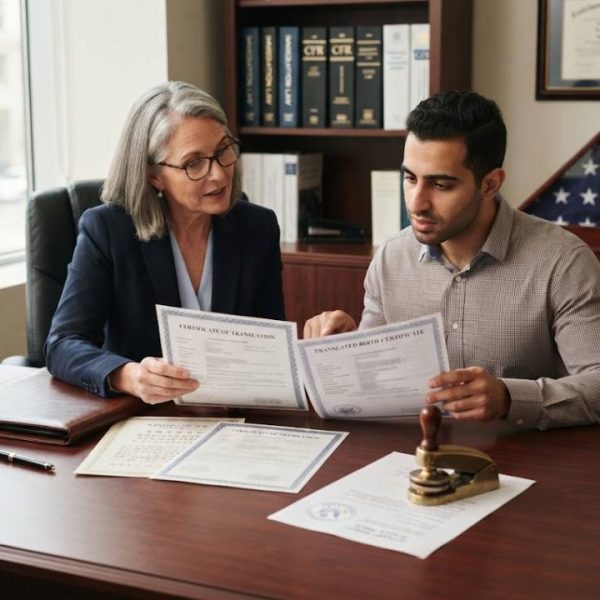
Applying for a green card, citizenship, a fiancé visa or asylum in the United States means submitting a stack of documents. If any of them are in Russian, US Citizenship and Immigration Services requires a full English translation. An incomplete or poorly certified translation is one of the most avoidable reasons for a Request for Evidence, which can delay a case by months.
Here is what USCIS expects from Russian to English translations and how to prepare your documents properly.
What USCIS Requires
According to USCIS rules, any document containing a foreign language must be accompanied by a full English translation. The translator must certify that the translation is complete and accurate, and that they are competent to translate from Russian into English. The certification includes the translator's name, signature, address and date.
USCIS does not require a sworn or notarised translation in most cases. What matters is completeness, accuracy and the certification statement.
Complete Means Complete
USCIS wants a translation of the entire document, not a summary. Stamps, seals, handwritten notes, marginal annotations and the back of the page must all be translated or described. Illegible text should be marked as illegible, not skipped. Partial translations are a common reason for rejection.
Documents Often Needed From Russian-Speaking Countries
- Birth certificates, including Soviet-era versions
- Marriage and divorce certificates
- Police clearance certificates
- Military service records
- Diplomas and academic transcripts
- Employment records and work books
- Name change certificates
Names Must Match
Russian names are written in Cyrillic, and transliteration systems differ. Your passport, visa and previous USCIS forms may already use a specific spelling. The translation should use the same spelling as your passport and immigration records. If an older document spells a name differently, the translator can add a note explaining the variation.
Soviet and Post-Soviet Documents
Many applicants were born in the USSR or in newly independent states in the early 1990s. Their documents may refer to cities and institutions that have since been renamed, or may be issued in Russian by authorities in Ukraine, Kazakhstan, Belarus or elsewhere. A skilled translator renders the document exactly as issued and may add clarifying notes where a place name has changed.
Dates and Formats
Russian documents write dates as day, month, year. US forms use month, day, year. A careless translation can turn 03.04.1990 from April 3 into March 4. Professional translators write months out in words or follow a clearly stated format to avoid any ambiguity.
Mixed-Language Files
Some families have documents in several languages. A Ukrainian birth certificate, a Russian marriage certificate and a German residence document might all be part of one case. A provider who offers a qualified Ukrainian translator and German to English translation services alongside Russian can deliver the whole set with consistent names and a uniform certification format.
Can You Translate Your Own Documents?
Technically, USCIS does not forbid applicants from using any competent translator, but translating your own documents or asking a family member is risky. The certification must be credible, and any doubt about accuracy can trigger additional scrutiny. Using a professional translator removes that uncertainty.
Common Reasons for Requests for Evidence
Immigration attorneys see the same translation problems again and again. The certification statement is missing or does not state the translator's competence. Only the front of a document is translated while the back carries stamps. A name appears in three different spellings across the file. A date is converted incorrectly. A translation summarises a document instead of rendering it in full. Each of these issues can prompt USCIS to ask for more evidence, adding weeks or months to the process. Checking translations against this list before filing is one of the simplest ways to protect your timeline.
Keep Copies of Everything
Keep digital and paper copies of every certified translation. The same documents are often needed again later, for example at a green card interview, a naturalisation application or when a family member files their own petition. Reusing an accurate, already certified translation saves time and money.
Digital Submissions
Many USCIS applications are now filed online. Certified translations are usually uploaded as PDF files alongside scans of the original documents. Make sure each translation is clearly matched to its original and that the certification page is included in the same file.
Costs and Turnaround
Standard certificates are often translated at a fixed price per page, with turnaround of one to three business days. Longer documents such as transcripts or court records cost more and take longer. Rush service is available when deadlines are tight.
Choosing a Provider
Look for experience with USCIS submissions, native English translators with strong Russian, clear certification wording and responsive support. PoliLingua's Russian translation services provide certified Russian to English translations for immigration, education and legal purposes.
The Takeaway
Immigration cases are stressful enough without avoidable paperwork problems. A complete, accurate and properly certified Russian translation helps your application move forward without unnecessary delays.